
Youth unemployment isn’t a single problem with a single fix. In Greece, Spain and Cyprus it has sat above the EU average for years. In Jordan and Egypt, before this project started, it reached roughly 50% and 20%. YouthLivingLabs was built to test a different approach to all of that: instead of another training course, put young people in front of a real company problem and see what they can do with it.
The project (Open Innovation Youth Living Labs Network, co-funded by the EU under Erasmus+, Grant Agreement No. 101185615) was run by five organisations: Instituto IKIGAI in Spain, who coordinated it, A.B. iED and Envolve Entrepreneurship in Greece, the Jordan Youth Innovation Forum, and JOVESOLIDES Egypt. Each brought a different piece of the puzzle, training design, mentoring, youth outreach, to build and test what the team called a Youth Living Lab: a local setup where young people aged 18 to 30 who are out of work, education or training get trained in open innovation, get matched with a real business challenge, and compete for a paid internship by solving it.
How it worked
It started with an open call. 341 people applied across the five countries, and 150 were selected to go through the programme, 58.1% of them women.
The first stretch was training: open innovation and design skills, delivered to the whole cohort. From there, the next step was to match participants with companies and start-ups that had submitted real challenges, and helped teams start shaping their ideas around them.
The core of the programme was the four-month mentoring cycle that followed. Around 25 teams worked with mentors from across the consortium, using the Double Diamond method — discover the problem, define it clearly, develop possible solutions, deliver a working prototype. It’s a structure originally built by the UK Design Council, adapted here with non-formal education methods suited to the age group. Over roughly 125 sessions, teams went from an open brief to something they could show to a company.
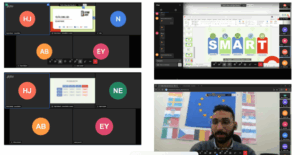
That’s what happened on 8 June, at the pitching workshop. All 25 teams presented their prototypes over Zoom, hosted by JYIF, to a panel of judges from each of the five partner countries. Three participants came out on top and are now doing paid international internships in Cyprus, Egypt and Spain, taking what they built straight into a real workplace.
What it adds up to
341 applications. 150 people trained. 25 teams, and roughly as many prototypes. Three of those people are now working abroad because of what they built.
Numbers aside, most of the people in this programme started it without a job and without a clear next step. Four months later, several of them had built something a real company looked at and said: yes, we’d hire you for this.
Next
The project isn’t done writing up what it learned. Work Package 7 is turning the model, what worked, what needed adjusting from one country to the next, into a guide other organisations can use to run their own Youth Living Lab.
YouthLivingLabs is co-funded by the European Union under the Erasmus+ programme (Grant Agreement No. 101185615).